 Last month, I had the opportunity to attend the BOOST (Best Out of School Time) Conference for the third time, and once again I was reminded why I think this may actually be one of the best education‑related conferences anywhere—not just for out‑of‑school time, but for anyone committed to young people and public education.
BOOST is action‑packed, high‑energy, and filled with people who are genuinely positive, supportive, and generous. In a moment when so much of the public education conversation is framed around struggle, defense, and scarcity, BOOST is a place rooted in hope, possibility, and believing in what’s still possible when people come together with intention.
The work and connections I experienced there brought to mind one of my favorite Mr. Rogers quotes:
“There is something of yourself that you leave at every meeting with another person.”
BOOST has become a place where that feels deeply real to me—because so many people I’ve met there have truly left something profound behind that I carry forward in my work.
This year, I had the honor of attending with two incredible partners and friends, Julia Sarmineto‑Cohn and Aleasha Stevens, who co‑presented with me. Together, we highlighted the partnerships between the Alliance for Public Schools, Hillsborough County Public Schools, and 7 Mindsets—partnerships rooted in trust and shared purpose, all focused on supporting student leaders in meaningful ways.
Our small partnership then became part of an even larger collaboration when we joined forces with Daniel Hatcher of Alliance for a Healthier Generation—my original BOOST buddy—to help create and support the ZEN Den. The ZEN Den became a space for conference participants to slow down, reconnect, breathe, and take care of themselves amid the excitement and energy of the conference. It was a reminder that caring for young people requires us to also care for ourselves—and that wellness is a collective responsibility.
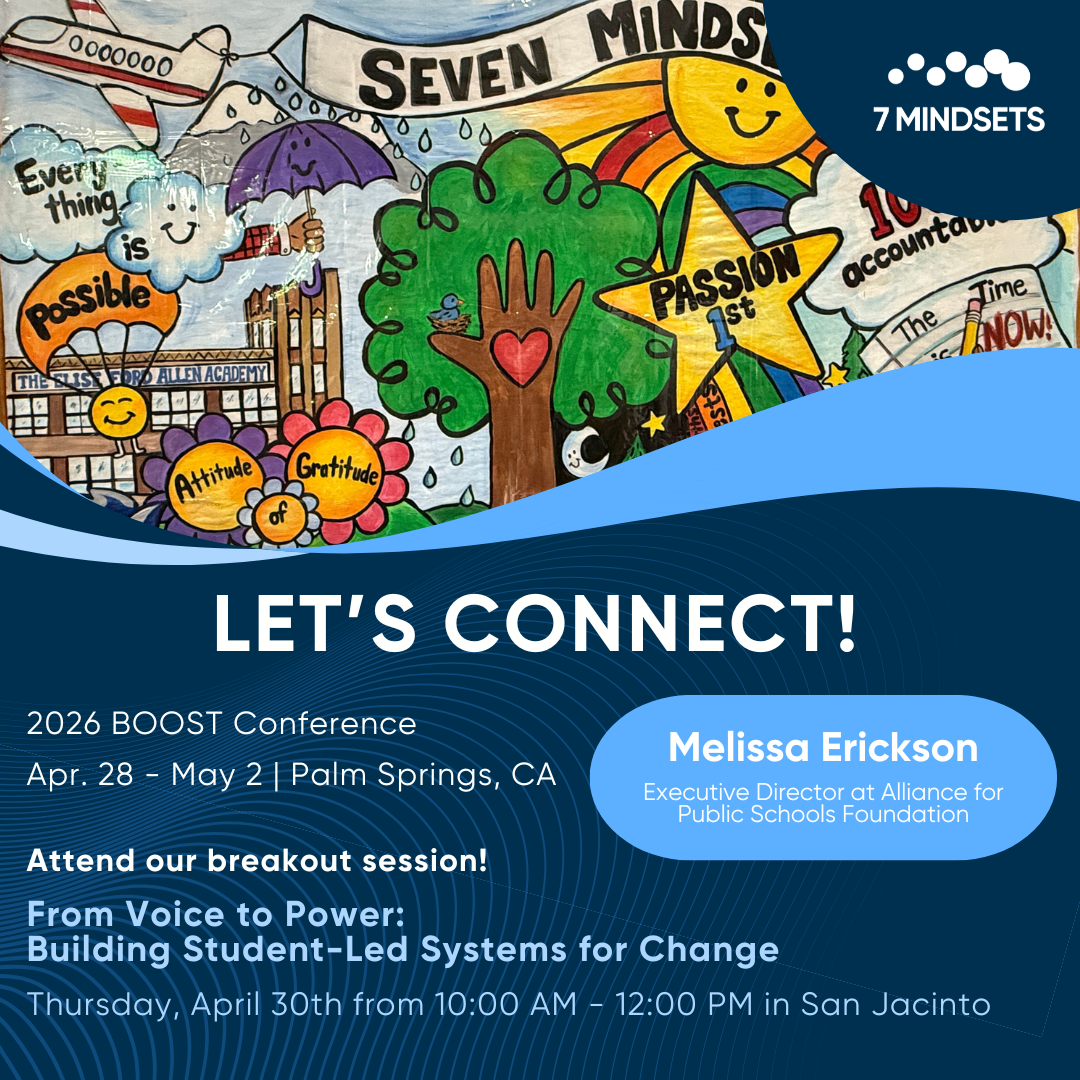
Another powerful moment for me was presenting our session focused on going beyond simply listening to student voice and instead sharing real decision‑making power with student leaders. We talked about what it looks like to treat students as essential stakeholders in the education ecosystem—not as symbolic participants, but as leaders with agency and influence.
Hearing from close to 100 educators from across the country was incredibly grounding and hopeful. Participants came from school districts, nonprofit organizations, partner agencies, and universities. Some are already doing deep work to fully integrate students into decision‑making processes. Others are just starting, curious and committed. Many are somewhere in between. What united them was a shared belief in young people and a genuine hope for the next generation of leaders.
I left that session feeling energized—not because the work is easy, but because there are so many people willing to do it thoughtfully and together.
I also want to offer deep thanks to everyone I interacted with at BOOST—the new connections, the familiar faces from previous years, and even surprise reunions like seeing William Wong now with Woodcraft Rangers, who I presented with on a legislative panel in DC more than a decade ago. Some conversations were long and meaningful. Others were brief hallway moments. But each one mattered.
I may not remember every name, and some encounters may have lasted only a few minutes, but I know this:
you left something with me—an idea, a reminder, a sense of belonging, or a renewed commitment to the work. And for that, I am deeply grateful.
BOOST continues to remind me that partnerships aren’t just about strategy or alignment. They’re about people showing up, sharing pieces of themselves, and building something better—together.